
Montgomery County Active Warrants
The Montgomery County Sheriff's Office outstanding-warrant roster is the direct public search for county warrants. It displays a searchable grid and opens a detail view through an internal folder number. The roster showed 12,233 entries when inspected on July 14, 2026, including warrants with old issue dates. That total is a snapshot, not a count of people who will be arrested today. An old row may need status review, and the grid does not state whether a warrant has been recalled, served, or cleared after later court action.
Montgomery County magistrates are part of the judicial branch. They use independent judgment to decide if probable cause supports an arrest warrant. Their jurisdiction includes misdemeanors and felonies outside Montgomery city limits, county traffic offenses often cited by state troopers or deputies, and worthless checks received in Montgomery County. A city misdemeanor usually belongs in City of Montgomery Municipal Court unless the same incident includes a felony or the person has a Sheriff's Office incident report. That venue split explains why a name may not appear in the county sheriff grid even when a city court matter exists.
The sheriff roster is an official starting point, but direct confirmation matters. The local court warns that an arrest warrant is not a public record until it has been served. A person who suspects an unserved warrant should call the Sheriff's Department or contact the relevant municipal magistrate instead of treating a blank online result as final.
Warrant information can also lead to several different records. The roster row identifies a warrant, while a later District or Circuit Court case records charges, hearings, pleas, rulings, costs, and disposition. A jail booking record shows custody after arrest. None of those records can be substituted for the others. The Sheriff's Office confirms custody and public warrant status; the magistrate explains the warrant process; the Circuit Clerk controls public state-court files; and Municipal Court controls city matters. Starting with the right office avoids treating a booking number, warrant number, and criminal case number as if they were one identifier.
Montgomery County Warrant Routes
Local warrant records reflect the court or case stream behind the process. The public roster shows prefixes such as GJ, DC, CC, TR, JU, WR, CS, and DA. Those codes can help route a question, but the inspected sheriff source does not define every prefix. Do not infer a charge or final court from a prefix alone. Ask the Sheriff's Office or issuing court to confirm it.
- County arrest warrant: A magistrate may issue it after sworn facts establish probable cause for a qualifying county offense.
- Municipal warrant: City misdemeanor, traffic, summons, bail, and related magistrate matters use the City of Montgomery Municipal Court route.
- Traffic-related warrant: A failure to appear or unresolved state, county, or city citation may create court action that requires confirmation with the court.
- Juvenile or restricted warrant: Public access may be limited because Alabama protects juvenile legal files and related confidential records.
- Federal warrant: Federal warrants are handled through federal law-enforcement and court channels, not the county public roster.
Search Montgomery County Warrants
The sheriff portal searches public outstanding-warrant rows by first name, last name, or warrant number. A broad name search can produce several people, so compare the displayed date of birth and issue date. The result grid supports sorting, filtering, refresh, and page sizes of 10, 25, or 50. Select View to open the corresponding warrant detail.
- Open the official outstanding-warrant roster and enter a first name, last name, or known warrant number in the search toolbar.
- Compare the full name and date of birth. Record the warrant number and issue date for the possible match.
- Open View for the detail page, but do not assume the detail includes an affidavit, bond, or current served status.
- Call the Montgomery County Sheriff's Department at (334) 832-4980 to confirm a suspected county warrant or ask which court controls it.
- For a city offense, use the City of Montgomery Municipal Court magistrate channel. For a court file, contact the Circuit Clerk or issuing court.
The official warrant grid is shown in the captured public view below.
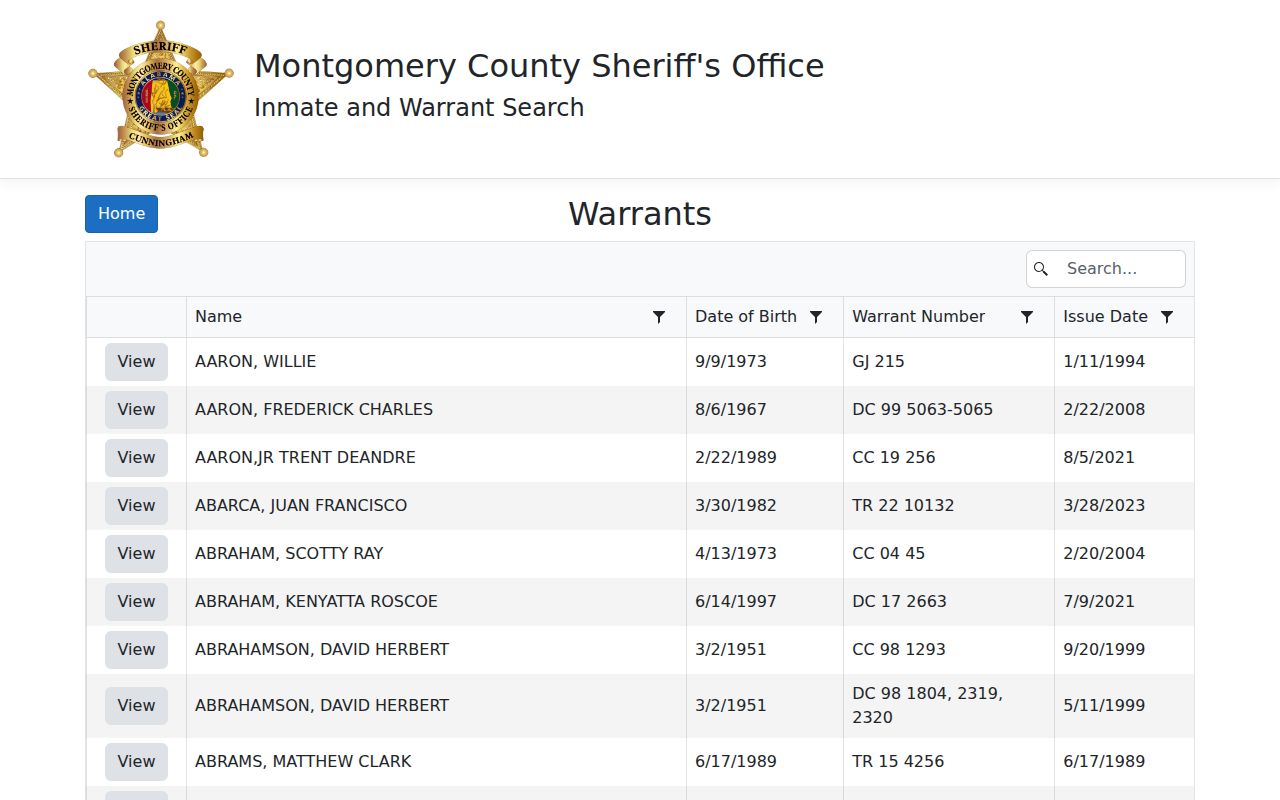
The roster's visible columns make identity checks possible while keeping the underlying warrant affidavit and probable-cause statement outside the grid.
The Montgomery County AL Sheriff mobile app is another official sheriff channel. Its Apple listing and Google Play listing identify the county app published by OCV. Use the app for sheriff search features, but confirm an urgent suspected warrant by phone because the court restricts unserved warrant information.
Montgomery County Warrant Search Fields
No field is required before the roster opens. The toolbar uses a contains search across the person's first name, last name, and warrant number. Date of birth and issue date are result fields, not search inputs in the inspected grid.
| Field Label | Type | Required | Notes |
|---|---|---|---|
| Search toolbar | Text | No | Searches first name, last name, and warrant number. |
| View | Button | No | Opens a detail page by hidden FolderNum. |
| Name | Result column | No | Shows the public full name. |
| Date of Birth | Date result | No | Use it to distinguish similar names. |
| Warrant Number | Text result | No | May begin with a routing prefix such as DC, CC, TR, or GJ. |
| Issue Date | Date result | No | Shows when the listed warrant was issued. |
Montgomery County Warrant Record Fields
A Montgomery County warrant result contains identity and routing clues, not the whole criminal case. The data model includes physical descriptors and a charges object, but those items may not appear in the basic grid and charges were often null in inspected data. The public record does not show a probable-cause affidavit or bond in the grid.
| Field | What It Shows |
|---|---|
| FolderNum | Hidden internal value used to open the warrant detail. |
| Warrant Number | Public identifier that may carry a court or case-stream prefix. |
| Name and DOB | Identity fields used to avoid confusing people with similar names. |
| Issue Date | Date associated with issuance of the listed warrant. |
| Race, gender, height, weight, hair | Data-model descriptors that are not all displayed as basic grid columns. |
| Charges | Model field that may be empty; the grid is not a full statement of charges. |
The official warrant detail view demonstrates how a selected roster row opens through its folder number.
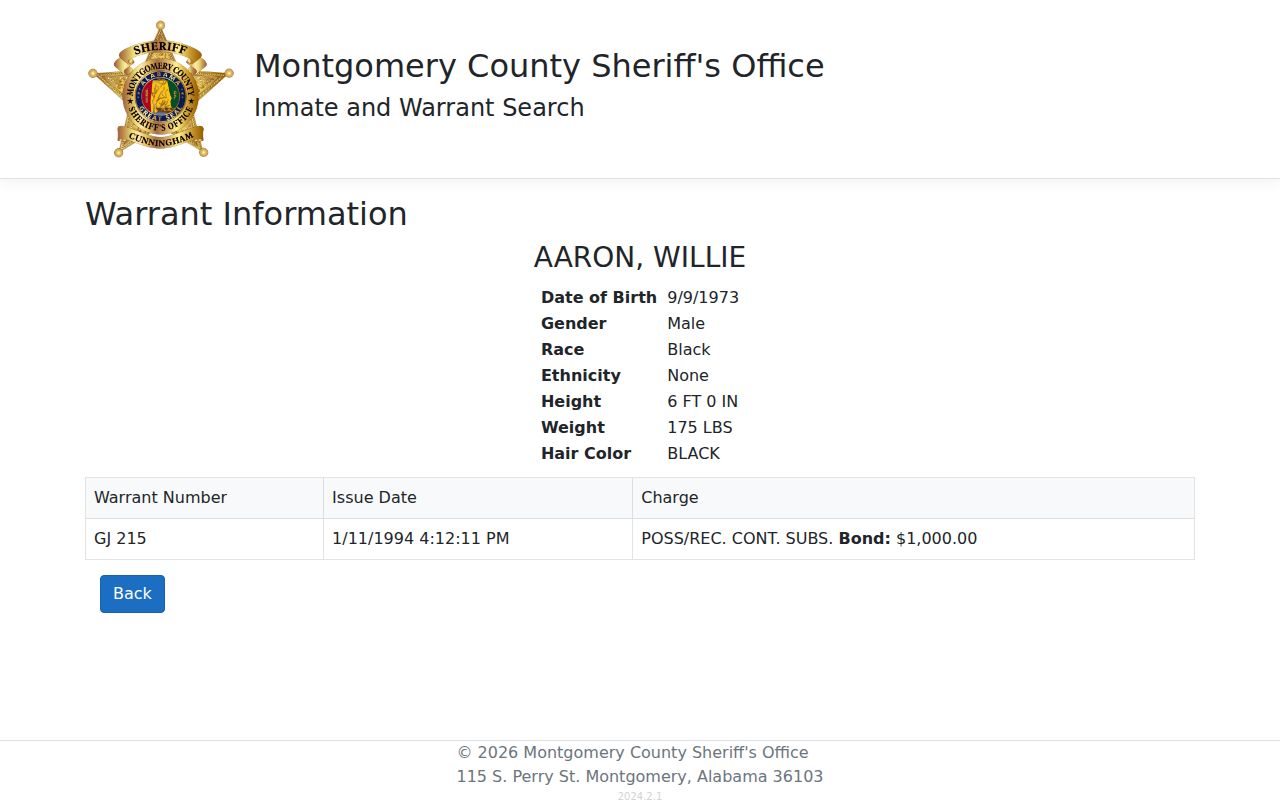
The detail screen remains a warrant lookup, not a substitute for the court case record, clerk file, or direct status confirmation.
Resolve a Montgomery County Warrant
First verify the match through the sheriff, the issuing court, or the City of Montgomery Municipal Court. Note the warrant number, prefix, full name, birth date, and issue date. Then ask which court controls the matter, whether bond has been set, whether an appearance is required, and where surrender or payment must occur. A traffic warrant, district criminal warrant, circuit matter, and city warrant can follow different paths.
Contact an attorney before appearing when arrest is possible. Payment alone should not be treated as proof that a warrant has been recalled. After the required appearance, surrender, bond, or payment, confirm that both the court and sheriff systems reflect the change. The research found no official update interval, so a short lag may remain between court action and the public roster.
Important: Confirm the issuing court and seek legal advice before surrender because a public roster row does not state every arrest or bond condition.
Apply for County Warrants
A complainant seeking a Montgomery County warrant must first file an incident or offense report with the Sheriff's Department at (334) 832-4980. For a felony, the complainant contacts the municipality with jurisdiction or the Sheriff's Department and speaks with an investigator. The officer or investigator comes to the Circuit Clerk's Office to obtain the warrant and may accompany the complainant before the magistrate.
The complainant is placed under oath and completes a deposition unless the officer has already done so. The magistrate reviews the sworn facts and decides if probable cause exists. If it does, the magistrate issues the arrest warrant. The local court states there is no cost to obtain a warrant. It also warns that charges are not dropped except in extenuating circumstances and that court costs may later apply. A warrant application is therefore a sworn court process, not an anonymous tip procedure.
The courthouse route serves qualifying county offenses. Misdemeanors inside Montgomery city limits belong with Municipal Court unless a felony is part of the incident or a Sheriff's Office report changes the route. For felony conduct, the complainant first works with the municipality that has jurisdiction or with a sheriff investigator. The officer or investigator, rather than an unsupported private request, takes the matter into the Clerk's Office process. This local division is why the location of the incident and the law-enforcement report matter at the start.
Montgomery County Sheriff's Office
115 South Perry Street
Montgomery, AL 36104
(334) 832-4980
Restricted Montgomery County Warrants
The most important limit is local and direct: an arrest warrant is not a public record until served. That rule means the sheriff's outstanding-warrant grid cannot be treated as a complete list of every suspected warrant. A direct call to the Sheriff's Department is the documented fallback. Served warrant records may become public, but linked juvenile, sealed, or expunged records can still be restricted.
NCIC and ACJIC warrant data are law-enforcement systems, not ordinary public databases. Federal warrants also use federal channels. The county grid does not disclose an affidavit, probable-cause statement, or the full court record. To inspect a public served-warrant record, ask the appropriate clerk or magistrate for the available record and identify the person, warrant number, and issuing court. For a full prosecution history, the Montgomery County criminal court record is the more complete source after a case opens.
Note: A missing online result does not disprove a warrant because unserved, municipal, juvenile, restricted, and federal matters may use other channels.
Public Record Search
Sponsored Results